Thursday, July 9, 2009

Return to Blogging

Nicenet


While reading Read’s “Tapping into Students’ Motivation: Lessons from Young Adolescents’ Blogs,” I came across a list of possible Blogs that wouldn’t be blocked by our school’s amazingly effective filter. While I have a facebook account, I’m not comfortable accepting the many “freind” requests from students, because it would limit what I share with my other “friends.” However, this site allows us to create blogs designed specifically for our students, allowing me to share with them classroom assignments, upcoming activities, samples of my writing, appropriate pics of my activities, etc.

It's free with no advertising, open only to participants to whom you've given the access code, and content can be edited or deleted by the teacher.

Classmates can post responses in a threaded fashion so that all of the individual comments follow the piece to which they are responded.

I won't have to teach them how to use the site as many (most?) are quite comfortable in digital environments.


edublogs


Yet another option for blogging in the classroom. Edublogs boasts "Blogging for teachers and students, made easy."

Effortlessly create and manage students blogs
Packed with useful features and customizable themes
Ready made for podcasting, videos, photos and more
Step by step support with our helpful video tutorials


I toyed around with the site a little and found it to be user friendly with tutorials for dummies like me. Oh, and the header pic on my sample is of my three kids at the beach because I had to find a way to include my little ones.

P.S. While creating this post, I had to call my wife, who's been blogging for a few years now, for a little support.

Our conversation:

Me: Hello is this blog support?
Joy: Ha ha, yes what do you need.
Me: I uploaded a second pic after some text and it automatically moved it to the top.
Joy: Oh yeah, you have to upload all pics first, then include your text.
Me: Thanks Babe. As always appreciate your help.
Joy: (With an Indian accent) Thank you for calling Blog Support and have a nice day.

Intelligent, beautiful and funny. Love that gal.

Monday, July 6, 2009

Old School


Unbeknownst (I love that word) to many, Joy and I sent our 5-yr-old son, Eli, to the SLO Classical Academy this past year.  We did so for many reasons, but suffice it to say that the 12 to 1 ratio was reason enough.  Before Eli attended his first day of school, his father, a public school teacher, was torn.  How would I defend myself?  Why would I have to defend myself? 
The questions would come and I needed an answer.  
I love everything about the classical model, and would love to teach in such an institution, yet also love my current job, with the joys and challenges that it brings.

When I first began thinking about a project/theses, I thought I'd research how to incorporate components of  a classical education into my classroom.  I quickly realized my limitations as part of a larger (public) beast.  I cannot simply transform my 8th grade curriculum. Aside from the obvious obstacles of district, state and federal accountability standards, my (diverse) students would not have been exposed to the grammar stage of a classical education.  There is, however, much crossover, such as teaching critical thinking, interdisciplinary units, and the heterogenous makeup of classes.   

After much research and myriad discussions with my amazing wife, I've come to the conclusion that I'm currently working where I need to be.  I've always had a heart for struggling readers.  

Now that the stage has been set. . . speaking of struggling readers. . . 

According to Alverman's "Literacy on the Edge," because many struggling readers find their own reasons for becoming literate. . . "it is important to offer them a variety of reading materials." She suggests everything from graphic novels to comic books and, while she doesn't propose that these supplant any "accepted" curriculum, she insists that taping into students' multiple literacies "can sometimes turn students around in terms of their perceptions of self-efficacy and motivation to read."  

Susan Wise Bauer, in Well-Educated Mind, differentiates between being informed and being enlightened.  "When you read," she says, "you develop wisdom - or in Mortimer Adler's words, "become enlightened." "To be informed," Adler writes in How to Read a Book, "is to know simply that something is the case.  To be enlightened is to know, in addition, what it is all about."  To be informed is to collect facts; to be enlightened is to understand an idea (justice, or charity, or human freedom) and use it to make sense of the facts you've gathered.

It is Bauer's assertion that we become informed by studying the Classics.  She rails against the futurists' claim that "we are a postliterate culture (where) books are outdated forms of communication" and multimedia will replace "boring print."

I don't see these ideas as mutually exclusive.  I fall somewhere in the "radical middle."  Why can't we tap into students' multiple literacies to help them become "enlightened"?  

So, here's my suggestion.  We hire enough public teachers to lower the class size to 12 to 1 instead of the recently increased 33 to 1.  We can do this one of three ways: paying teachers significantly less than they deserve (not a new idea); coupling smaller schools with corporations, institutions of higher learning, or NPOs in a mutually beneficial arrangement; waiting for nuclear holocaust where there will be significantly fewer children to educate.  
I'm thinking option number two has the most promise.

Thoughts?


Thursday, July 2, 2009

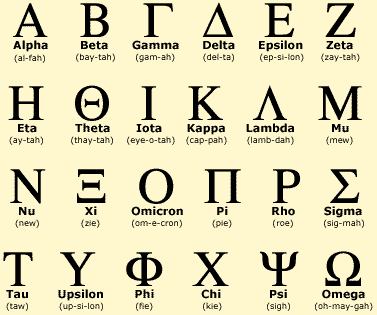
It's All Greek to Me!


I'm currently reading Surely You're Joking Mr. Feynman!, about the experiences of a Nobel Prize winning physicist.  Last night I read about his teaching experiences at a university in Brazil.  I'll include a LONG excerpt here and then pose a couple of questions for discussion.
When he was done with his teaching at the university, he was asked to deliver a speech to the students, profs, dean, etc.  

Towards the end, he said "The main purpose of my talk is to demonstrate to you that no science is being taught in Brazil!" 
I can see them stir, thinking, "What?  No science?  This is absolutely crazy!  We have all these classes."
So I tell them that one of the first things to strike me when I came to Brazil was to see elementary school kids in bookstores, buying physics books.  There are so many kids learning physics in Brazil, beginning much earlier than kids do in the United States, that it's amazing you don't find many physicists in Brazil - why is that?  So many kids are working so hard, and nothing comes of it.
Then I gave the analogy of a Greek scholar who loves the Greek language, who knows that in his own country there aren't any children studying Greek.  But he comes to another country, where he is delighted to find everybody studying Greek - even the smaller kids in the elementary schools.  He goes to the examination of a student who is coming to get his degree in Greek, and asks him, "What were Socrates' ideas on the relationship between Truth and Beauty?" - and the student can't answer.  Then he asks the student, "What did Socrates say to Plato in the Third Symposium?"  The student lights up and goes, "Brrrrrrrrrrr-up" - he tells you everything , word for word, that Socrates said, in beautiful Greek.
But what Socrates was talking about in the Third Symposium was the relationship between Truth and Beauty!
What this Greek scholar discovers is the students in another country learn Greek by first learning to pronounce the letters, then the words, and then sentences and paragraphs.  They can recite, word for word, what Socrates said, without realizing that those Greek words actually mean something. To the student they are all artificial sounds.  Nobody has ever translated them into words the students can understand.
I said, "That's how it looks to me, when I see you teaching the kids 'science' here in Brazil."
. . . Finally, I said that I couldn't see how anyone could be educated by this self-propagating system in which people pass exams, and teach others to pass exams, but nobody knows anything. . . . One student who had done well in class stood up and said, "I was educated here in Brazil during the war, when, fortunately, all of the professors had left the university, so I learned everything by reading alone.  Therefore I was not really educated under the Brazilian system."

Observations/Questions 

1) Tests may tell us if students can answer a few questions, but not if they can raise them.  While we as language arts teachers are charged with the responsibility for helping kids learn to read and write, that task isn't simply a matter of teaching decoding and subject-verb agreement.  It is the more important - and more difficult - matter of teaching thoughtful reading, questioning, reasoning (Probst). 

2) We have all dealt with students for whom the A was much more important than the understanding or competence it was supposed to represent.  For the past few years, I've tried to convince our administration that time in the day for SSR (sustained silent reading) would be beneficial.  Students enjoy a self-selected book and read it because it's meaningful, pertinent, challenging, real, etc.  Not because I assigned it to them.  The pressure we teachers and students face to do well on standardized testing has become so intense that our ability to teach and students' ability (and desire) to pursue knowledge and learn how to think critically have taken a back seat.  *How can we meld the demands of our administration, district, state and federal mandates with what we know is best for our students?  Mustn't we build upon our students existing strengths and not search for holes to plug so that they might score "Proficient" on the STAR?

3) The Brazilian student who claimed that he learned because his professor was not there to teach, but by reading alone poses an interesting question.  Can a great book alone serve as a great teacher?  Is a mentor a necessary component in learning from that great book?  

Wednesday, July 1, 2009

Frustration


After I read all the books Dr. Herter loaned me, and conducted all the "research" I could without access to Poly's database, I had a dilemma.  My classroom computer, which has served as my office for the summer, is great for searching Google News or checking my stocks. However, if I want to access any of the databases from Poly, they're all blocked.   Love that filter, tech services. The backdoor approaches I learned from my students didn't even allow me access beyond the first page.  So, I could try to work at home with my three small children underfoot, or drive to Poly daily.  I didn't like either choice as my classroom is directly around the corner and has thus far been ideal. Solution: Save articles as PDFs, and email them to my school where I can view or print them.  [Click on image to view screen capture with 15 emails above]  

How must our students feel when they are asked to research a project and, at every turn, are blocked due to "inappropriate" content.  And teachers who wish to blog with students?  Or students who wish to add to their own blogs on their own time (lunch, after school, etc.).  I understand the necessity of a filter (avoiding litigation :)), yet, for the first time, side with my students as they constantly complain about their lack of access and are told that school computers are for "educational purposes only."  Interesting that our IT dept. determines what is "educational."  

Maybe the twelfth message down, Technology Toolkit, will have some helpful ideas.  
Or maybe you do.  Anybody?  Anybody?

Monday, June 29, 2009

Rosenblatt

My assessments frequently rely on an efferent stance while my Journals take a more aesthetic stance.  It seems the goal would be to combine the two, yet the time commitment to read/discuss/evaluate such a response might be overwhelming, considering my 150 students.
One "assessment" I've created that combines the two would be my Digital Poetry project. Students are to find a poem which they appreciate and then, through selections of images, colors, fonts, music, etc., create a multimedia presentation in which their understanding of the poem is clear and the personal connection is implied.  They are to work at understanding the poem at various levels and understand that the meaning of the poem is variable with multiple valid interpretations.  
Following are a couple of student examples.

Peterson

Check out this SlideShare Presentation:

Dashboard

Check out this SlideShare Presentation: